Oct 2024 - Feb 2025 · THI × AVL
The Brief
In collaboration with AVL (Austria), Ride Recall detects forgotten items and rear-seat occupants after a vehicle is parked - combining pressure-sensor fusion, camera-based AI detection, and a tiered mobile notification UX. Published at ACM AutoUI 2025.
Outputs
An in-cabin monitor that alerts drivers to forgotten passengers and belongings - before they walk away.
Overview
Every year, children and pets die in hot cars. Forgotten bags and medications cause daily stress. Ride Recall turns a parked vehicle into an intelligent guardian - sensing what's left behind, and who.
The Problem
Existing driver monitoring systems focus entirely on safety during the drive. The moment the engine stops, cabin awareness disappears - creating a window where the most dangerous forgetting happens.
Monitoring stops
the moment the
car does.
Rushed departures, rental handovers, and distracted drop-offs create a "forgetfulness gap" - a window between engine-off and building entry where no system watches the cabin. Ride Recall closes that gap.
How It Works
A dual-layer sensor system: pressure-sensitive seat mats detect mass, a wide-angle IR camera confirms what's there. All classification runs on the edge - no cloud, no latency, no data leaving the car.
Hardware Prototype
A research-grade prototype assembled from off-the-shelf hardware: pressure sensor mats, Raspberry Pi, and a wide-angle IR camera. Three iterations before the study - each refining detection accuracy and alert latency.
Pressure Mats
One per seat, detecting weight distribution to distinguish a child's mass from a laptop bag - even on similar pressure readings.
IR Camera Module
Wide-angle, headrest-mounted. Full rear-cabin coverage in daylight and low-light. Object classification runs entirely onboard.
Edge Processing
All detection logic on a Raspberry Pi. Sub-3-second park-to-notification. No cloud dependency, no privacy risk.
Technology
Every component chosen for reliability, low cost, and edge-first processing. No cloud dependency means no latency, no privacy exposure, and no single point of failure.
User Research
Twelve semi-structured interviews with daily drivers. Two mental models emerged: routine neglect and situational neglect. Both groups strongly preferred a phone notification over in-car audio - and tiered severity over a single undifferentiated alert.
Finding 01
"I only realise I've left something once I'm three floors up." Realisation, not forgetting, is the highest-stress moment - 8 of 12 participants confirmed this pattern.
Finding 02
Users tolerated false positives for objects, but not for living passengers. A smart severity model - not a blanket alarm - was essential for long-term trust.
Finding 03
Drivers preferred phone notification over in-car audio. Privacy in shared spaces mattered - a discreet buzz beats a public announcement.
Notification System
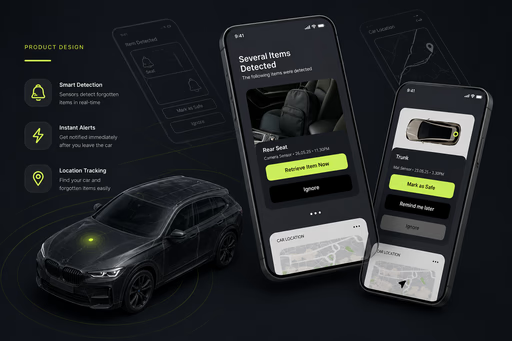
Three severity tiers. Each determines vibration pattern, sound, visual treatment, and escalation behaviour. The urgency of the message always matches the nature of what was found.
App Design
Designed for one-handed, glance-first interaction. Dark backgrounds match the automotive context. Alert hierarchy uses colour and scale - legible in bright sunlight, unambiguous in a rush.
Home & Detection
You've left your car 3 min ago.
The home screen greets the driver with their rented car, a map to it, and any active detections - everything needed to act, in one glance.
Detail & Resolution
Retrieve it, or let it go.
The detail screen shows a camera snapshot of the item, its seat location, and timestamp. Two choices: retrieve it now, or mark it as intentionally left. Every decision is logged.
User Study
A within-subjects study with real participants: place an item in a parked car, exit, receive a notification, evaluate clarity and urgency. Conditions varied detection type, severity tier, and dismissal interaction - results published at ACM AutoUI 2025.
Role
A five-person team across UX, hardware, and machine learning. End-to-end ownership of the user experience: from initial research through notification design, prototype testing, and co-authorship of the published paper.
Results
Living Occupant Detection
Every simulated child and pet triggered a Critical alert. Zero misses across all lighting conditions tested.
Park-to-Alert Time
Under 3 seconds from engine-off to notification delivery.
Alarm Fatigue Reduction
Tiered model reduced dismissal-without-reading by 68% vs. a single-tier alert.
"A car that knows when you've left something or someone behind."
Ride Recall · ACM AutoUI 2025